
TL;DR
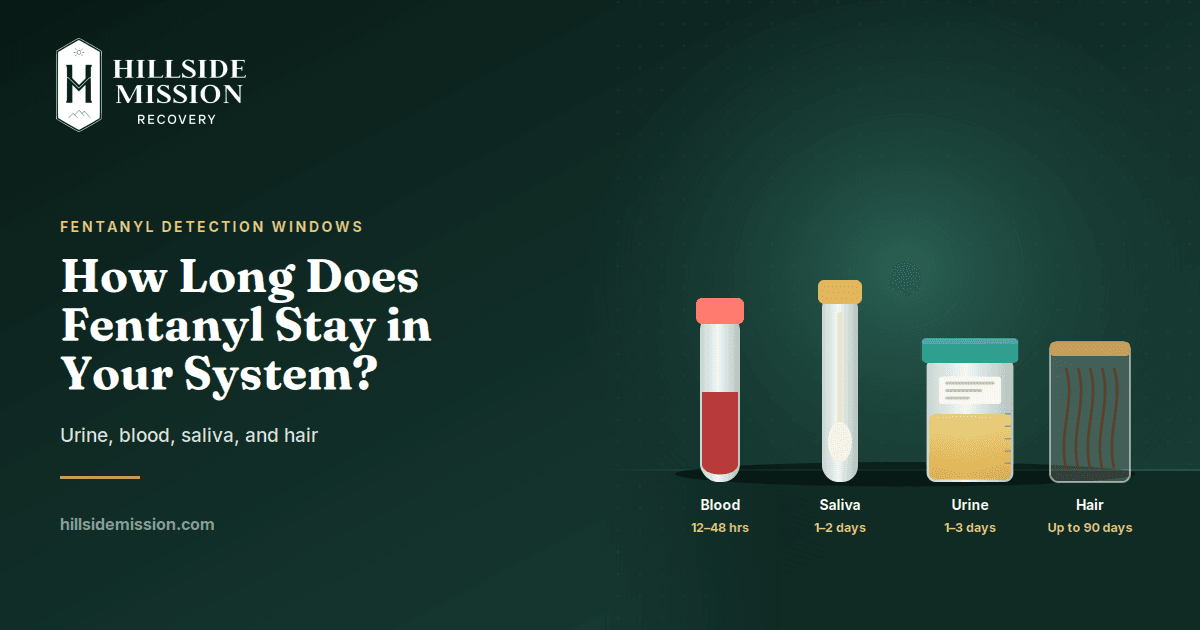
Typical detection windows: blood about 12 to 48 hours, saliva about 1 to 2 days, urine about 1 to 3 days, and hair up to 90 days. Heavy or long-term use can stretch each window.
Many standard 5-panel and 10-panel drug tests do not look for fentanyl unless it is added on.
A negative test does not mean you are safe. Lower tolerance after a break raises overdose risk.
Nothing flushes fentanyl out faster. Stopping suddenly without medical support can be hard and risky, and medical detox exists for this.
Hillside Mission Recovery can help you or someone you love start treatment.
Table of Contents
Why drug test results don't tell the whole story: risks and overdose safety
When to seek help: fentanyl treatment at Hillside Mission Recovery
Introduction
You may be asking how long does fentanyl stay in your system because of a drug test, a worry about a family member, or a fear about what happens if you stop. Whatever the reason, you deserve a straight answer without judgment.
The short version is that fentanyl leaves the body in days, but tests can pick up traces for different lengths of time depending on the sample. The numbers below are general ranges, not guarantees, and they come from commonly used clinical testing ranges rather than a single study. Your own result can differ.
What is fentanyl and how does the body process it?
Fentanyl is a synthetic opioid, made entirely in a lab. It is approved as a prescription pain medicine, but most fentanyl involved in the current overdose crisis is made illegally.[1] The DEA describes it as about 100 times more potent than morphine, with a rapid onset and a short duration of effects.[2]
The liver breaks fentanyl down, and the body clears it mostly through urine. The main breakdown product is called norfentanyl. Many urine tests look for norfentanyl rather than fentanyl itself, because it lasts longer. If you want the basics on why the drug is so strong, we cover that in our guide to fentanyl potency. This article stays on timing.

How long fentanyl stays in urine, blood, saliva, and hair
The answer to how long does fentanyl stay in your system depends on which sample is tested. Each one looks back over a different stretch of time.
Test type | Typical detection window | Notes |
|---|---|---|
Urine | About 1 to 3 days after last use | Most common test. Often looks for norfentanyl. Longer after heavy or long-term use. |
Blood | About 12 to 48 hours | Shows recent use. Used in hospitals and some investigations. |
Saliva | About 1 to 2 days | Short window. Less common for fentanyl. |
Hair | Up to about 90 days | Shows a pattern of use, not the exact day. Takes days to show up after use. |
Urine
For most people, how long fentanyl stays in urine is roughly one to three days. People who have used heavily for a long time sometimes test positive for longer, because the drug builds up in body fat and is released slowly.
Blood and saliva
Blood and saliva have the shortest windows. They are better at showing very recent use than past use.
Hair
Hair holds a record for weeks to months. A standard sample covers about 90 days. It cannot tell a lab when you used, only that you did at some point in that period.

Factors that change how long fentanyl stays in your system
Two people can use the same amount and test differently. These things move the window:
How often and how much you use. Regular use leads to buildup and longer detection.
Form of fentanyl. Patches and extended-release products release the drug slowly, so traces can last longer than after a single dose.
Body fat. Fentanyl dissolves in fat, which can hold on to it.
Liver and kidney health. Slower organs mean slower clearing.
Age and other medicines. Some drugs change how the liver handles fentanyl.
Test sensitivity. Labs set different cutoff levels.
If you are trying to work out how long does fentanyl stay in your system for a specific test, ask the testing lab or a doctor for its cutoff level and method.

Fentanyl half-life, effects, and withdrawal timeline
Half-life is the time it takes the body to clear half of a drug. For a single injected dose, fentanyl's half-life is short, often a few hours. After long-term use or with patches, it can run much longer, sometimes a day or more. Pain relief, sedation, nausea, and slowed breathing come on quickly and fade quickly after a single dose, which matches the DEA's description of a short duration of effect.[2]
Withdrawal follows a different clock than testing. Symptoms often begin within about 8 to 24 hours of the last dose, peak in the first few days, and ease over about a week. They can include aches, sweating, nausea, diarrhea, anxiety, and restlessness. Some people have trouble sleeping, low mood, and cravings for weeks or longer. Opioid withdrawal is rarely life-threatening on its own, but it is miserable, and it is a common reason people return to use.
This is where how long fentanyl stays in your system and how long it affects you part ways. A clean urine test can come while cravings are still strong.

Why drug test results don't tell the whole story: risks and overdose safety
Many standard 5-panel and 10-panel urine screens do not include fentanyl. A person can pass one and still have used it. Fentanyl needs its own test or a broader panel.
The bigger concern is safety. After days or weeks without opioids, tolerance drops. A dose that once felt manageable can now stop your breathing. NIDA notes that even a small amount can cause a fatal overdose, including when a person takes fentanyl without knowing it because it was added to counterfeit pills or other illegal drugs.[1] The CDC reported more than 73,000 overdose deaths involving synthetic opioids (excluding methadone), which includes fentanyl, in the United States in 2022.[2]
Keep naloxone (Narcan) where you can reach it. See our step-by-step Narcan guide for families.
Use fentanyl test strips, which NIDA says can reduce risk.[1]
Do not use alone.
Naloxone can reverse a fentanyl overdose,[2] but call 911 anyway.

When to seek help: fentanyl treatment at Hillside Mission Recovery
If you are looking up how long does fentanyl stay in your system because you want to stop, that is a good reason to talk with someone today. SAMHSA runs a National Helpline and a treatment locator at FindTreatment.gov for free, confidential referrals.[3]
At Hillside Mission Recovery, medical detox manages withdrawal with clinical monitoring so you are not facing the worst days alone. From there, many people move into residential inpatient care. If anxiety, depression, or trauma are part of the picture, dual diagnosis treatment addresses both together. Aftercare and alumni support continues after you leave.
Treatment plans are matched to the person. The American Society of Addiction Medicine (ASAM) publishes the criteria used to build person-centered plans for addiction and co-occurring conditions.[4] If you are not sure it is time, read 9 signs it's time to consider rehab, or see what to expect in drug rehab.
Frequently Asked Questions
Q: How long does fentanyl stay in your urine after last use?
A: Usually about one to three days. Heavy or long-term use can make it last longer, and the exact window depends on the lab's cutoff level.
Q: Can fentanyl be detected in a standard 5-panel or 10-panel drug test?
A: Often not. Many standard panels do not include fentanyl. It usually needs a specific fentanyl or norfentanyl test. Ask the testing provider what is on the panel.
Q: Does fentanyl stay in your system longer if you use it regularly or take extended-release patches?
A: Yes, it can. Regular use causes buildup, and patches release the drug slowly over time. Both can lengthen the detection window compared with a single dose.
Q: How long does fentanyl withdrawal last, and when do symptoms start?
A: Symptoms often start within about 8 to 24 hours after the last dose, peak in the first few days, and ease over about a week. Mood and sleep problems and cravings can linger. Medical detox can make this safer and more bearable.
Q: Can you flush fentanyl out of your system faster, and what is the safest way to stop using it?
A: No. Water, detox drinks, and exercise do not speed it up in any reliable way. The safest way to stop is with medical support, because withdrawal is hard and returning to use after a break carries a high overdose risk.
Conclusion
So, how long does fentanyl stay in your system? Roughly 12 to 48 hours in blood, 1 to 2 days in saliva, 1 to 3 days in urine, and up to 90 days in hair, with real variation from person to person. What matters more is what comes next. If you want to stop using, you do not have to wait for a test to clear or for things to get worse. Contact Hillside Mission Recovery at hillsidemission.com to talk through detox and treatment options. For help after you leave, read about aftercare and relapse prevention, and if you are a family member, see how to support a loved one through rehab.
References
National Institute on Drug Abuse. Fentanyl. https://nida.nih.gov/research-topics/fentanyl
Drug Enforcement Administration, Diversion Control Division. Fentanyl. https://www.deadiversion.usdoj.gov/drug_chem_info/fentanyl.pdf
Substance Abuse and Mental Health Services Administration. Substance Use Disorder Treatment. https://www.samhsa.gov/substance-use/treatment
American Society of Addiction Medicine. ASAM: American Society of Addiction Medicine. https://www.asam.org
Ready to take the next step?
If you or someone you love is struggling, Hillside Mission is here to help — confidentially, 24/7.