TL;DR
Couples rehab Orange County programs let two partners enter treatment at the same time, with individual care for each person and joint sessions for the relationship.
Getting sober together can give you a shared goal and a shared language. It can also pull both of you down if one person slips.
Couples treatment is not right for every pair. Violence, coercion, or one partner who is not willing to stop are reasons to treat separately first.
Detox, if needed, is medical care for each person on their own. Staying together does not change that.
To get started, call Hillside Mission Recovery, or use the SAMHSA helpline at 1-800-662-HELP (4357).[1]
Table of Contents
Can you and your partner get sober together? Benefits and risks
How to choose a couples rehab program and take the first step
Introduction
You use together. Maybe you drink together every night, or one of you started and the other followed. Now you both want out, and the first fear is that treatment will split you up.
It does not always have to. Couples rehab Orange County programs exist for exactly this situation, and they can work well for the right pair. This article explains how they run, who they suit, who they do not, and how to decide. If you want an overview of any rehab stay first, our first-timer's guide to drug rehab in Orange County covers the basics.
What is couples rehab and how does it work?
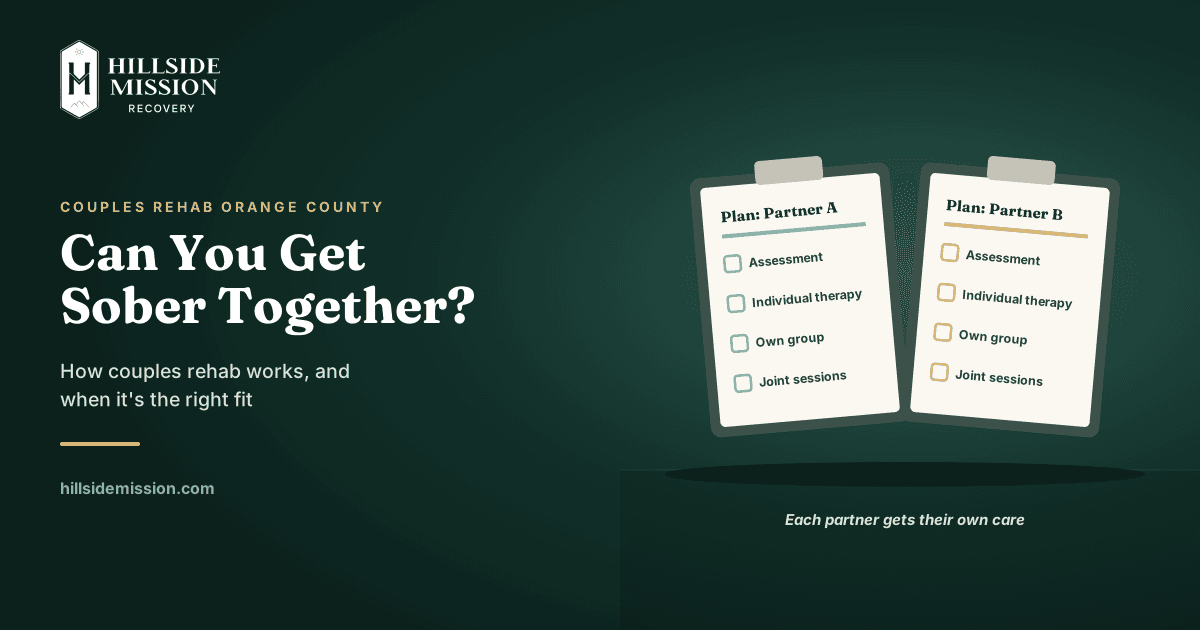
Couples rehab is addiction treatment where two partners enroll in the same program at the same time. Each of you gets your own assessment, your own treatment plan, and your own clinician. You also meet together with a therapist for sessions about the relationship.
That split matters. Addiction is a medical condition in each person, not a problem the relationship has as a unit. The American Society of Addiction Medicine describes its treatment guidelines, the ASAM Criteria, as a person-centered approach to building plans for people with addiction and co-occurring conditions.[2] Person-centered means your plan is built around you, even when your partner is down the hall.
A couples rehab Orange County program usually runs on three tracks:
Individual care: one-on-one therapy, medical review, and a plan for each partner.
Separate groups: so each of you can speak freely about things you may not say in front of your partner.
Joint sessions: scheduled time with a couples therapist.

Can you and your partner get sober together? Benefits and risks
Yes, many couples do. There are two sides to it, and you should see both before you commit.
Possible benefit | Possible risk |
|---|---|
You are not leaving a partner who is still using at home. | If one of you leaves treatment early, the other may feel pressure to leave too. |
You learn the same relapse warning signs and can name them to each other. | You may become each other's trigger, especially during conflict. |
Home life can be rebuilt around sobriety by both people. | One partner may do the work while the other coasts, which breeds resentment. |
No one waits at home wondering how the other is doing. | Focus on the relationship can crowd out your own recovery. |
Your own treatment has to come first. A good program will tell you that plainly, even if it sounds backwards in a couples program. If you stay sober only for the relationship, a breakup can become a relapse.

When couples treatment is not the right fit
Some situations call for separate programs, at least at first. A clinician will ask about these during assessment, and you should answer honestly.
There is violence, threats, or control in the relationship. Safety comes before any joint therapy.
One partner is not willing to stop. Treatment you are forced into rarely holds.
One of you needs a different level of care, such as medical detox or treatment for a serious mental health condition.
The relationship itself is the main source of stress and drug use, and neither of you can be calm in the same room yet.
None of this means you must end the relationship. It means you may need to recover side by side in separate programs, then do couples work later. If anxiety, depression, or trauma is part of your story, read how dual diagnosis care in Orange County works, and see our dual diagnosis program.

What to expect from couples rehab in Orange County
The first step is detox if either of you needs it. Alcohol and some drugs can cause dangerous withdrawal, so this is medical care, done for each person separately. Our medical detox team monitors each patient on their own schedule, because two people rarely withdraw at the same pace.
After detox, many couples move into residential inpatient care. Days are structured: individual sessions, group therapy, meals, and time to rest. Joint sessions are scheduled, not constant. Whether you share a room depends on the facility's policy and clinical judgment, so ask directly before you enroll. Rooming arrangements and group assignments vary between programs.
If you are weighing a residential stay against a lighter schedule, our comparison of intensive outpatient and outpatient rehab explains the differences in hours and structure.

Therapies for individual and relationship recovery
Medication is part of care for some people. The National Institute on Drug Abuse states that medications for opioid use disorder are safe, effective, and save lives.[3] For alcohol, the National Institute on Alcohol Abuse and Alcoholism maintains a treatment navigator for people looking at their options.[4] If one of you takes medication and the other does not, that is normal. Plans differ.
Talk therapy does the rest of the work:
Individual therapy to look at your own history, triggers, and any trauma.
Group therapy with peers who are not your partner.
Couples sessions on trust, honesty, money, and how you argue.
Family sessions when children or parents are affected.
Couples work often starts with simple agreements, such as how you will tell each other about a craving. Small, specific rules help more than big promises.

Staying sober as a couple after treatment
Leaving treatment is where couples often struggle. The house still has the old routines, the old friends, and maybe the old supply. Before discharge, clear the home of alcohol and drugs, and decide together who you will call when one of you is shaky.
Keep some recovery separate. Each of you should have your own meetings, your own counselor, and your own sober friends. Our aftercare and alumni program supports that, and our post on building an aftercare and relapse prevention plan walks through triggers and sober living.
If one of you relapses, the other's job is not to hide it or fix it. It is to call the treatment team and protect their own sobriety first. If an opioid overdose is possible, know the steps in our Narcan guide for families.

How to choose a couples rehab program and take the first step
Not every facility that advertises couples care runs it the same way. Before you pick a couples rehab Orange County program, ask these questions:
Does each partner get a separate assessment and individual therapist?
What happens to one partner if the other leaves early?
Are medical detox and mental health care available on site?
Do you share a room, and who decides?
What does aftercare look like for each of you?
You can also search for programs through FindTreatment.gov, which SAMHSA runs, or call the national helpline.[1] If you are unsure whether it is time, 9 signs it is time to consider an Orange County rehab program may help. If you are the only one making the calls, our guide on supporting a loved one through rehab speaks to that side.
Frequently Asked Questions
Q: Can my partner and I go to rehab together in Orange County?
A: Often yes, if a clinical assessment shows it is safe and helpful for both of you. Each of you is assessed on your own first. Hillside Mission Recovery can talk through your situation by phone before you decide.
Q: Will we share a room, or be in the same therapy groups?
A: It depends on the program. Many keep individual and group therapy separate so each person can speak openly, and schedule joint sessions on top of that. Ask any facility about its room policy before you enroll.
Q: Is couples rehab effective, or is it better to get treatment separately?
A: It depends on the couple. Couples treatment can work well when both people are willing and the relationship is safe. Separate treatment is better when there is violence, coercion, or very different medical needs. A clinician can help you decide.
Q: What if only one of us is ready to get sober?
A: The partner who is ready should not wait. Enter treatment, and build a plan for returning to a home where the other person may still be using. Pushing a partner into rehab rarely works, but your own recovery is possible either way.
Q: Does insurance cover couples rehab in Orange County, and how do we verify benefits?
A: Insurance usually covers each person's treatment under their own plan, not "couples" as a category. Each of you will need your own benefits check. Call Hillside Mission Recovery with your insurance cards and the admissions team can verify coverage for both of you.
Conclusion
Getting sober together is possible, and couples rehab Orange County programs are built for it. The best ones treat you as two people with two plans and one relationship worth protecting. If that is not safe or workable right now, separate treatment is not a failure. It is a different route to the same place.
If you and your partner are ready to talk about it, contact Hillside Mission Recovery. One call can answer whether couples care fits you, what detox would involve, and what coverage you have. If you need help right now, call SAMHSA at 1-800-662-HELP (4357) or 988 for a crisis.[1]
References
Substance Abuse and Mental Health Services Administration. Home | SAMHSA. - https://www.samhsa.gov
American Society of Addiction Medicine. ASAM - American Society of Addiction Medicine. - https://www.asam.org
National Institute on Drug Abuse. NIDA.NIH.GOV | National Institute on Drug Abuse (NIDA). - https://nida.nih.gov
National Institute on Alcohol Abuse and Alcoholism. National Institute on Alcohol Abuse and Alcoholism (NIAAA). - https://www.niaaa.nih.gov
Ready to take the next step?
If you or someone you love is struggling, Hillside Mission is here to help — confidentially, 24/7.