TL;DR
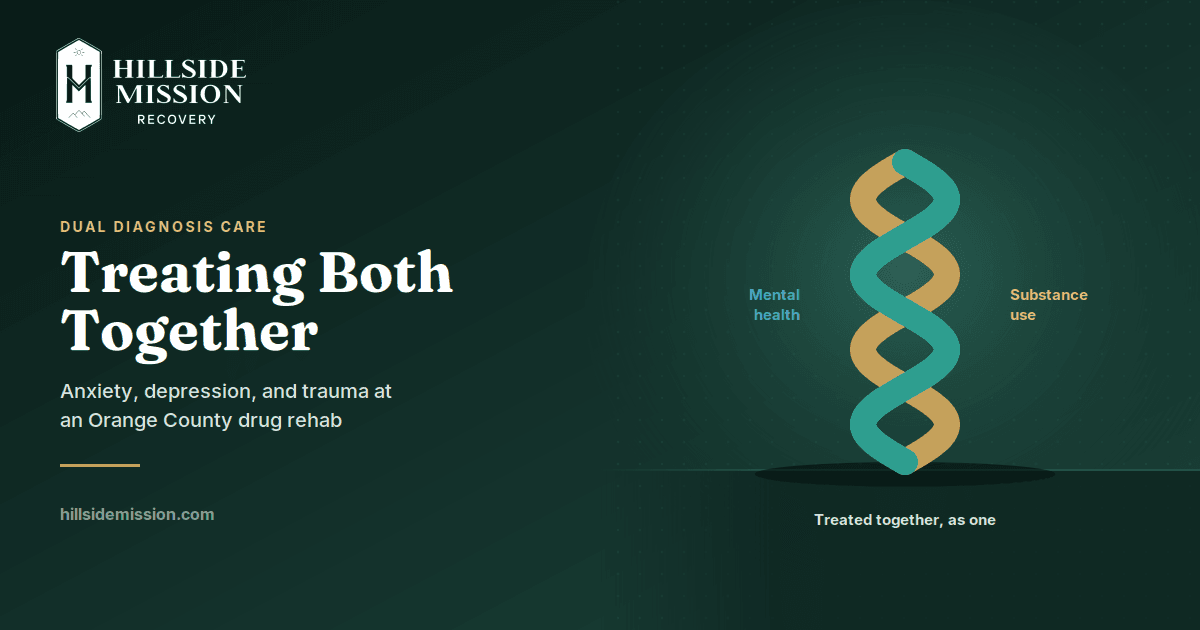
Dual diagnosis means you have a substance use disorder and a mental health condition at the same time. It is common, not rare.
Treating both together is usually better than treating them one after the other, according to the National Institute on Drug Abuse.[1]
A good Orange County drug rehab starts with a full assessment so it can tell which symptoms came from substances and which came first.
Trauma-informed care, medication management, and a long aftercare plan all belong in the same program.
Ask any program who diagnoses, who prescribes, and how therapists and doctors talk to each other.
Table of Contents
What is dual diagnosis and why does it matter in addiction recovery?
How anxiety, depression, and trauma fuel substance use (and vice versa)
Comprehensive assessment: how an Orange County drug rehab identifies co-occurring disorders
Trauma-informed care: healing the root causes, not just the symptoms
Aftercare and relapse prevention for long-term mental health and sobriety
How to choose a dual diagnosis program at an Orange County drug rehab
Introduction
You may have told yourself the drinking or drug use was the problem, and that once it stopped, the panic, the flat gray mood, or the nightmares would go away. Then they did not. Or maybe you got sober before, and the anxiety got so loud that you went back to using just to get through a day.
That pattern is common, and it has a name. An Orange County drug rehab that treats dual diagnosis does not ask you to pick which problem to work on first. This article explains how that kind of care works, what the first weeks look like, and how to judge whether a program is really doing it. If you are earlier in the process and unsure whether treatment is needed at all, our guide to signs it is time to consider an Orange County rehab program is a better starting point.
What is dual diagnosis and why does it matter in addiction recovery?
Dual diagnosis is the older, everyday term for co-occurring disorders. NIDA defines these as mental disorders or other health conditions a person has at the same time, which can affect each other's symptoms and outcomes.[1]
The numbers are large. In the 2023 National Survey on Drug Use and Health, 35% of U.S. adults with a mental disorder also had a substance use disorder.[1] NIDA also reports that people with both conditions typically have a harder time staying in treatment and following treatment guidelines, which leads to worse health outcomes.[1]
That second finding is why this matters. If depression is left alone, it can push you out of a program in week three. If drinking is left alone, it can blunt the medication meant to treat the depression. Each condition makes the other harder to treat.

How anxiety, depression, and trauma fuel substance use (and vice versa)
NIDA notes that shared risk factors, including genes, personal traits, and social environment, can contribute to both substance use and other mental disorders.[1] So one does not simply cause the other. The link often runs in both directions.
Condition | How it can drive use | How use can make it worse |
|---|---|---|
Anxiety | Alcohol or sedatives feel like the only way to calm racing thoughts or social fear | Anxiety often rebounds harder as substances wear off or during withdrawal |
Depression | Stimulants or alcohol offer a short lift or numbness | Heavy use can deepen low mood, disrupt sleep, and weaken energy |
Trauma | Substances dull flashbacks, hypervigilance, and nightmares | Intoxication raises risk of new harm, and sobriety can bring memories back with no coping tools |
This is why willpower alone so often fails. You are fighting a craving, and you are also fighting whatever the substance was quieting.

Comprehensive assessment: how an Orange County drug rehab identifies co-occurring disorders
The hardest question at intake is also the most common one: is this anxiety, or is this withdrawal? Is this depression, or is it three weeks of heavy drinking? A careful Orange County drug rehab does not guess. It builds a timeline.
Expect questions like these:
When did the symptoms start, and were you using then?
Did they ever ease during a long stretch of sobriety?
Is there a family history of mental illness or addiction?
Have you lived through violence, loss, abuse, combat, or a serious accident?
What medications are you taking now, and which have you tried before?
Some answers only become clear after detox. Our medical detox gives your body time to stabilize, and then clinicians can reassess what remains. The ASAM Criteria, Fourth Edition, from the American Society of Addiction Medicine, is a set of guidelines built around a person-centered approach to treatment plans for addiction and co-occurring conditions.[2] Programs that follow it match your level of care to your actual needs, not to a standard package.

Integrated treatment at an Orange County drug rehab: therapy, medication management, and support under one roof
Integrated means one team, one plan. Your therapist knows what your psychiatric prescriber changed on Tuesday. Your prescriber knows what came up in group on Monday. NIDA states that treating co-occurring conditions at the same time, rather than separately, can make all the treatments more effective and improve health outcomes.[1]
In practice, an integrated plan at an Orange County drug rehab usually includes:
Individual therapy that addresses both substance use triggers and mood or anxiety symptoms
Group sessions where others describe the same double struggle
Medication review by a qualified prescriber, with attention to how substances interact with each drug
Skills practice for sleep, stress, and cravings
Family sessions, when you want them
Here is how that differs from the split model many people have tried before.
Question | Separate care | Integrated care |
|---|---|---|
Who sees the whole picture? | Nobody, unless you carry notes between offices | One coordinated team |
What if symptoms flare in early sobriety? | You may be told to get sober first, or to see someone else | The same team adjusts the plan |
Medication and substance use | Often handled by different providers | Reviewed together |
You can read more about how we approach this on our dual diagnosis page. Daily structure matters too, and our residential inpatient program gives you a stable place to start while symptoms are at their loudest.

Trauma-informed care: healing the root causes, not just the symptoms
Trauma-informed care starts from a simple question: what happened to you, not what is wrong with you. Staff avoid forcing you to retell your story before you are ready. You get a say in your schedule, your room, and your pace.
The therapy itself usually comes in stages. First comes stabilization: sleep, grounding skills, and ways to ride out a craving or a flashback. Processing the memories comes later, with a trained clinician, once you have tools to stay steady. Rushing that order is how people leave treatment worse off.
This is the part of dual diagnosis care that can feel slow. It also tends to explain why a person relapsed after earlier treatment that never touched the trauma.

Aftercare and relapse prevention for long-term mental health and sobriety
Leaving treatment is a high-risk moment for both conditions. Routine disappears, old places return, and stress comes back. A dual diagnosis aftercare plan has to name both kinds of warning signs: the early signs of a craving, and the early signs of a mood or anxiety slide.
That plan can include outpatient therapy, ongoing medication follow-up, peer support, and sober living. Our aftercare and alumni program is built for this stretch, and our post on how a rehab facility builds an aftercare and relapse prevention plan walks through the pieces. If you are weighing step-down options, see intensive outpatient versus outpatient rehab.

How to choose a dual diagnosis program at an Orange County drug rehab
Plenty of programs say they treat co-occurring disorders. Ask each Orange County drug rehab you call these questions, and listen for specific answers:
Who diagnoses mental health conditions, and what are their credentials?
Is a prescriber involved, and how often do you see them?
How do therapists and medical staff share information?
Which trauma therapies do you offer, and when in treatment do they begin?
What happens to my mental health care after I leave?
Vague answers are a warning sign. If you are supporting someone else through this search, our guide on supporting a loved one through rehab in Orange County covers your side of it, and what to expect in drug rehab in Orange County covers the practical first days.
Alcohol is part of many dual diagnosis cases. The National Institute on Alcohol Abuse and Alcoholism publishes statistics on alcohol use disorder and treatment across age groups and demographics, which can help you see how common this is.[3] You are not an outlier.
Frequently Asked Questions
Q: What does dual diagnosis mean at an Orange County drug rehab?
A: It means the program treats a substance use disorder and a mental health condition, such as anxiety, depression, or PTSD, as connected problems in one coordinated plan. NIDA calls these co-occurring disorders.[1]
Q: Can addiction and mental health disorders like anxiety or depression really be treated at the same time?
A: Yes. NIDA says treating co-occurring conditions at the same time is usually better than treating them separately, and that doing so can make all the treatments more effective.[1] Early sobriety can be hard on mood, so having both handled by one team helps.
Q: How do I know if I have a co-occurring disorder or if substance use is causing my symptoms?
A: You often cannot tell on your own. Symptoms that started before you used, or that continue after weeks of sobriety, point toward a separate condition. A clinical assessment that builds a timeline and allows for detox is the reliable way to sort it out.
Q: What types of therapy are used to treat trauma and addiction together?
A: Programs commonly use cognitive behavioral therapy, dual-focused trauma therapies, and skills-based approaches for managing distress and cravings. Some also offer EMDR. Ask which ones a program provides and who delivers them, since methods vary by facility.
Q: Does insurance cover dual diagnosis treatment in Orange County, and how do I verify my benefits?
A: Coverage depends on your plan, so we cannot promise it here. The quickest way to find out is to call the number on your insurance card, or contact Hillside Mission Recovery through our website and our team can help you check your benefits.
Conclusion
Addiction and anxiety, depression, or trauma tend to travel together, and treatment works better when it treats them together. A strong Orange County drug rehab will assess carefully, coordinate therapy and medication, go at your pace on trauma, and plan for the months after discharge.
If you or someone you love is looking for an Orange County drug rehab that takes both problems seriously, Hillside Mission Recovery can talk through your situation and your options. Reach out through hillsidemission.com. One call is enough to start.
References
National Institute on Drug Abuse. Co-Occurring Disorders and Health Conditions. - https://nida.nih.gov/research-topics/comorbidity
American Society of Addiction Medicine. The ASAM Criteria, Fourth Edition. - https://www.asam.org
National Institute on Alcohol Abuse and Alcoholism. (2025). Alcohol Facts and Statistics. - https://www.niaaa.nih.gov/alcohols-effects-health/alcohol-topics/alcohol-facts-and-statistics
Ready to take the next step?
If you or someone you love is struggling, Hillside Mission is here to help — confidentially, 24/7.